
The Night Stalker of Central India
My First Encounter with the Net-Casting Spider In Outpost 12, Kanha.
While I usually start my "spider talks" with the legendary Portia jumping spider, there is another arachnid that truly pulled me into the world of spiders: the Net-casting spider (Asianopis). This species consistently amazes me with its specialized hunting techniques and masterful camouflage.
The Transformation of the Landscape
When I first began searching for spiders at Outpost 12, it was my first summer in the Central Indian landscape. At first, there wasn't much happening, and I'll admit I was a bit disappointed. Then, the rains arrived.
The transformation was divine. Everything changed. The life around me became incredible. Suddenly, there were insects, snakes and spiders everywhere you looked.
A Surprise in the Shadows
One night, after dinner, I was walking a guest back to their room. I have a habit that never leaves me; I tend to flash my torch into the bushes rather than on the path. More often than not, this curiosity pays off.
Suddenly, I saw something hanging from a single silk thread. From a distance, it looked like a small, discarded twig. But as a naturalist, I couldn't leave it unexamined. I asked my guest for a moment, leaned in and took a closer look. At first glance, I thought it might be a Nursery Web spider (Pisauridae).
But the naturalist in me couldn't sit quiet. I gently touched the leg of the spider, and it suddenly sprang to life, climbing up its web.
The "Ogre" Eyes
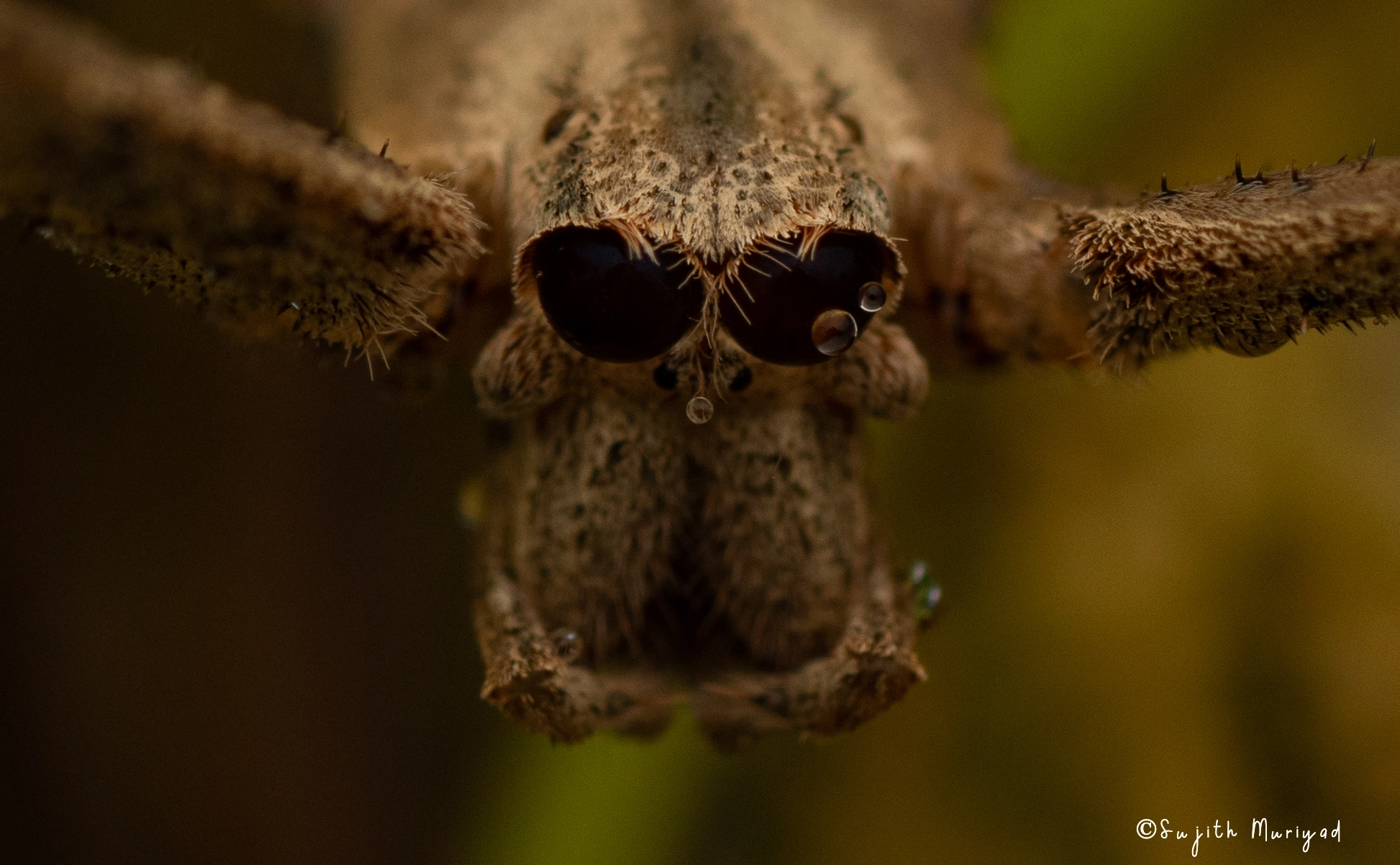
Then, I saw those eyes.
I don't remember exactly what I said, but I remember screaming with excitement. I think I actually scared my guest! I beckoned them closer, pointing at this tiny creature hanging in the dark. They looked at it, unimpressed and said, "It's just a spider... why are you screaming?"
That's when I started explaining just how special this one really is.
Way they hunt: Unlike most spiders that wait for prey to hit a web, these guys weave a small, rectangular "fishing net." They fold it, hold it between their front legs and wait. When prey gets close, they expand the net and scoop the insect up - sometimes even catching them mid-air!
Super-powered Vision: Their eyes are the real marvel. With an aperture of f/0.58, they can see in pitch-black conditions. To put that in perspective, an owl's aperture is around f/1.13, and a human's is roughly f/2.1.
Daily regeneration: They can absorb 2,000 times more light than a human eye. Because they lack pupils to control light intake, daylight actually destroys their light-sensitive membrane (rhabdomere) every single day. Every night, they have to re-synthesize that entire layer of their eye just to hunt again.
The One That Got Away
By the time I showed my guest a video of the spider hunting and a photo of its daytime camouflage, they finally understood my excitement.
My plan was simple: drop the guest off, run back for my camera and photograph my first-ever Net-caster in this region. I was gone for barely 20 minutes. When I returned, my heart was pounding with excitement... but the place was empty! It had performed a total vanishing act.
In the months that followed, we found many more net-casting spiders - some hunting, some with egg sacs and even tiny spiderlings. But nothing will ever beat the adrenaline of that first sighting in the Central Indian rain.